


Updated March 16, 2026
By FINSSURE Editorial Team
Finding the best car insurance is not really about finding one company with the lowest ad price. It is about finding the policy that fits your car, budget, state requirements, and risk tolerance. That is where many drivers get stuck. A cheap quote can leave you underinsured, while a premium policy can include extras you do not need. This guide explains how to compare insurers, coverage, and trade-offs so you can choose with more confidence.
Quick Answer
There is no single best car insurance company for everyone. The right choice depends on your state, driving record, vehicle, budget, and whether you value low rates, local agents, military eligibility, usage-based discounts, or premium add-ons.
Key Takeaways
- The best policy is the one with the right limits, deductible, and service for your situation.
- State minimum coverage is often not enough to protect your savings after a serious crash.
- Compare quotes using the same limits and deductibles, or the prices are not truly comparable.
- Regional insurers can be excellent, but many have limited state availability.
- Usage-based programs can help safe drivers save, but they are not a fit for everyone.
What “best” means in car insurance
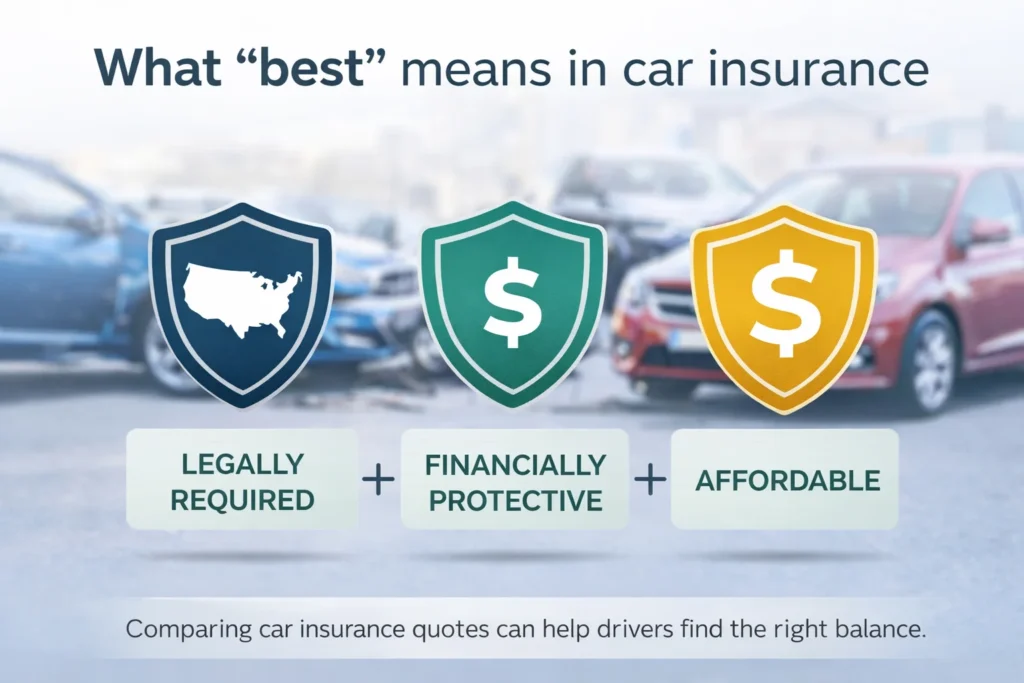
A good car insurance policy does three jobs at once. It keeps you legal in your state, protects your finances after a crash, and gives you a price you can live with.
That means the best insurer for one driver can be the wrong fit for another. A military family may start with USAA. A driver who wants a large agent network may prefer State Farm. Someone who values regional service and rate stability may want to compare Erie. A budget-focused shopper may start with GEICO or Progressive. A driver with a new vehicle may care more about features like new car replacement.
The mistake is assuming “best” means cheapest. Price matters, but so do policy limits, deductibles, exclusions, optional coverages, and claims support.
How car insurance works
Car insurance is a contract. You pay a premium, which is the price of the policy. In exchange, the insurer agrees to cover certain losses up to your policy limits.
If you have a covered claim on your own vehicle, you may pay a deductible first. That is your out-of-pocket share before the insurer pays the rest. In plain English, a higher deductible usually lowers your premium, but it also means you take on more risk when a claim happens.
Here are the core terms that matter most:
- Liability: Pays for injuries or property damage you cause to others.
- Collision: Pays to repair or replace your car after a crash, regardless of fault.
- Comprehensive: Pays for non-collision losses such as theft, hail, fire, vandalism, or animal strikes.
- Exclusion: A situation the policy does not cover.
- Endorsement: An add-on that changes or expands the policy.
- Actual cash value: What your car was worth right before a covered loss, after depreciation.
- Replacement cost: The cost to replace property without subtracting depreciation. In auto insurance, this usually applies only through special endorsements, not standard coverage.
What coverage most drivers should consider
Most states require liability coverage, but legal minimums can be too low in a serious accident. If you cause major injuries or expensive property damage, the bills can easily exceed minimum limits.
For many drivers, a practical baseline looks like this:
- Liability limits higher than the state minimum
- Collision and comprehensive if the car is financed, leased, newer, or still worth protecting
- Uninsured or underinsured motorist coverage where available and important in your state
- Medical payments or personal injury protection where relevant
- Rental reimbursement or roadside assistance only if you value the convenience
If you have a loan or lease, your lender will usually require collision and comprehensive. If your car is older and worth little, dropping those coverages can make sense, but only after you consider what you could afford to replace out of pocket.
Providers worth comparing first
The table below is not a universal ranking. It is a practical shortlist of insurers that stand out for different reasons.
| Insurer | Best for | Why it stands out | Watch-out |
|---|---|---|---|
| State Farm | Drivers who want agent support | Large agent network, telematics discount, rideshare option | Not always the cheapest |
| GEICO | Budget-minded drivers | Broad discount menu, strong digital tools, often competitive pricing | Less ideal if you strongly prefer local agent relationships |
| Progressive | Drivers open to telematics and flexible pricing | Snapshot, accident forgiveness, rideshare option | Telematics is not for everyone |
| Travelers | Newer cars and feature shoppers | New car replacement option, telematics, broad coverage menu | Savings and features vary by state |
| USAA | Military families | Strong military focus, telematics discounts, broad member value | Eligibility rules apply |
| Erie | Drivers in eligible states who want rate stability | Rate Lock feature, strong regional reputation | Limited state footprint |
| Amica | Service-focused shoppers | Strong customization, premium package options | May not be the lowest quote |
| Auto-Owners | Drivers who want an independent agent | Broad add-ons and agent-guided shopping | No direct-online-first model |
Best fit by driver type
A “best for” label only helps when it is tied to an actual need.
If you want a local agent and hands-on help, State Farm and Auto-Owners are sensible starting points. They appeal to drivers who want to talk through limits, deductibles, and endorsements instead of handling everything through an app.
If you are mostly focused on price, GEICO and Progressive are worth checking early. They both advertise broad discount opportunities, and Progressive puts heavy emphasis on telematics and quote comparison tools.
If you are in a military household, USAA belongs on your shortlist first. The key caveat is simple: not everyone qualifies.
If you drive for a rideshare platform, look closely at State Farm and Progressive, because rideshare coverage gaps are a real issue. Personal auto insurance alone may not fully protect you while you are logged in and waiting for a request.
If you own a newer vehicle, Travelers deserves a look because add-ons like new car replacement can matter more than saving a few dollars a month.
If you live in one of Erie’s operating states and want predictability, Erie is worth a serious quote. Its Rate Lock feature is one of the clearest differentiators in this market.
How to compare quotes the right way
This is where many shoppers go wrong. They compare price without comparing the policy itself.
Use the same vehicle, drivers, limits, and deductibles on every quote. If one insurer quotes state minimum liability and another quotes higher limits with collision and comprehensive, the cheaper quote is not an apples-to-apples win.
Before you compare, gather:
- Driver’s license information
- Vehicle identification number or exact vehicle details
- Current insurer and coverage details
- Prior claims and violations
- Estimated annual mileage
- Garaging address
- Loan or lease information
A smart approach is to pull your current declarations page and use it as a reference. That helps you match limits and deductibles across quotes.
Common discounts to ask about
Discounts vary by company and state, but these are the ones most likely to matter:
- Bundling auto with home, renters, or another policy
- Multi-car
- Good driver
- Good student
- Defensive driving or driver training
- Low mileage
- Paid in full
- Automatic payments
- Paperless billing
- Usage-based or telematics programs
Do not assume every discount is worth chasing. A telematics program can save money for safe, low-risk drivers, but some shoppers will not like app-based monitoring. Others may prefer a stable traditional policy even if the price is slightly higher.
Mistakes to avoid
The biggest mistake is buying based on price alone. The second biggest is carrying limits that are too low to protect your income, savings, or future earnings.
Other common errors include choosing a deductible you could not comfortably cover tomorrow, forgetting to ask about exclusions, dropping collision and comprehensive too early, and ignoring membership or availability rules for regional or affinity insurers.
Another easy mistake is failing to revisit your policy after a move, marriage, teen driver, new car, or paid-off loan. Those life changes can reshape what “best” looks like.
A simple way to choose
Start by deciding what problem you are trying to solve.
If your goal is the lowest workable premium, compare direct insurers and ask about discounts. If your goal is stronger service and advice, compare agent-driven companies too. If your goal is protecting a newer car, look harder at optional coverages and replacement-style features.
Then narrow your decision to the quote that gives you the best balance of:
- price
- coverage limits
- deductible
- optional protections
- service model
- eligibility and availability in your state
That balance matters more than any national “No. 1” list.
FAQs
Is the cheapest car insurance the best choice?
Not always. The cheapest policy may have lower liability limits, fewer add-ons, or a deductible that is too high for your budget.
Is full coverage worth it?
Often yes for financed, leased, or newer vehicles. For older cars with low market value, collision and comprehensive may be worth dropping, but only if you can afford to replace the car yourself.
How many car insurance quotes should I compare?
At least three is a practical minimum. More can help if you have a teen driver, tickets, an accident history, or a rideshare exposure.
What is a good deductible for car insurance?
Many drivers choose $500 or $1,000. The right amount depends on how much you could pay out of pocket after a covered loss.
Does car insurance cover theft and storm damage?
That usually falls under comprehensive coverage, not liability or collision.
Can I switch car insurance anytime?
Usually yes, but make sure your new policy starts before the old one ends so you do not create a coverage lapse.
Methodology
For this article, FINSSURE reviewed current insurer auto coverage pages, discount pages, eligibility pages, and feature pages available as of March 16, 2026. We also reviewed NAIC consumer guidance and AM Best financial-strength materials that were publicly available. Our picks are not universal rankings. They are starting points based on verified features, availability, consumer usefulness, and financial-strength context. Rates, discounts, and endorsements vary by state, driver profile, and vehicle.
Sources
- National Association of Insurance Commissioners, “Auto Insurance.”
- NAIC, “A Consumer’s Guide to Auto Insurance.”
- State Farm auto pages, including Drive Safe & Save, rideshare coverage, and agent information.
- GEICO auto insurance, discounts, and financial strength pages.
- Progressive auto, discounts, Snapshot, rideshare, and accident forgiveness pages.
- Travelers coverage, discounts, IntelliDrive, and new car replacement pages.
- USAA membership, auto, and SafePilot pages.
- Erie, Amica, and Auto-Owners official auto pages.
Conclusion
The best car insurance is the policy that fits your risk, not the one with the loudest marketing. Start with enough liability coverage, compare matching quotes, and pay close attention to deductibles, exclusions, and optional features. A national “best” list can help you build a shortlist, but your own quote details should decide the winner. Your next step is simple: pull your current declarations page and compare at least three quotes on the same coverage terms.
CTA
Ready to shop smarter? Use your current policy limits as a template and compare three insurers side by side before you switch.