

Updated March 16, 2026 | By FINSSURE Editorial Team
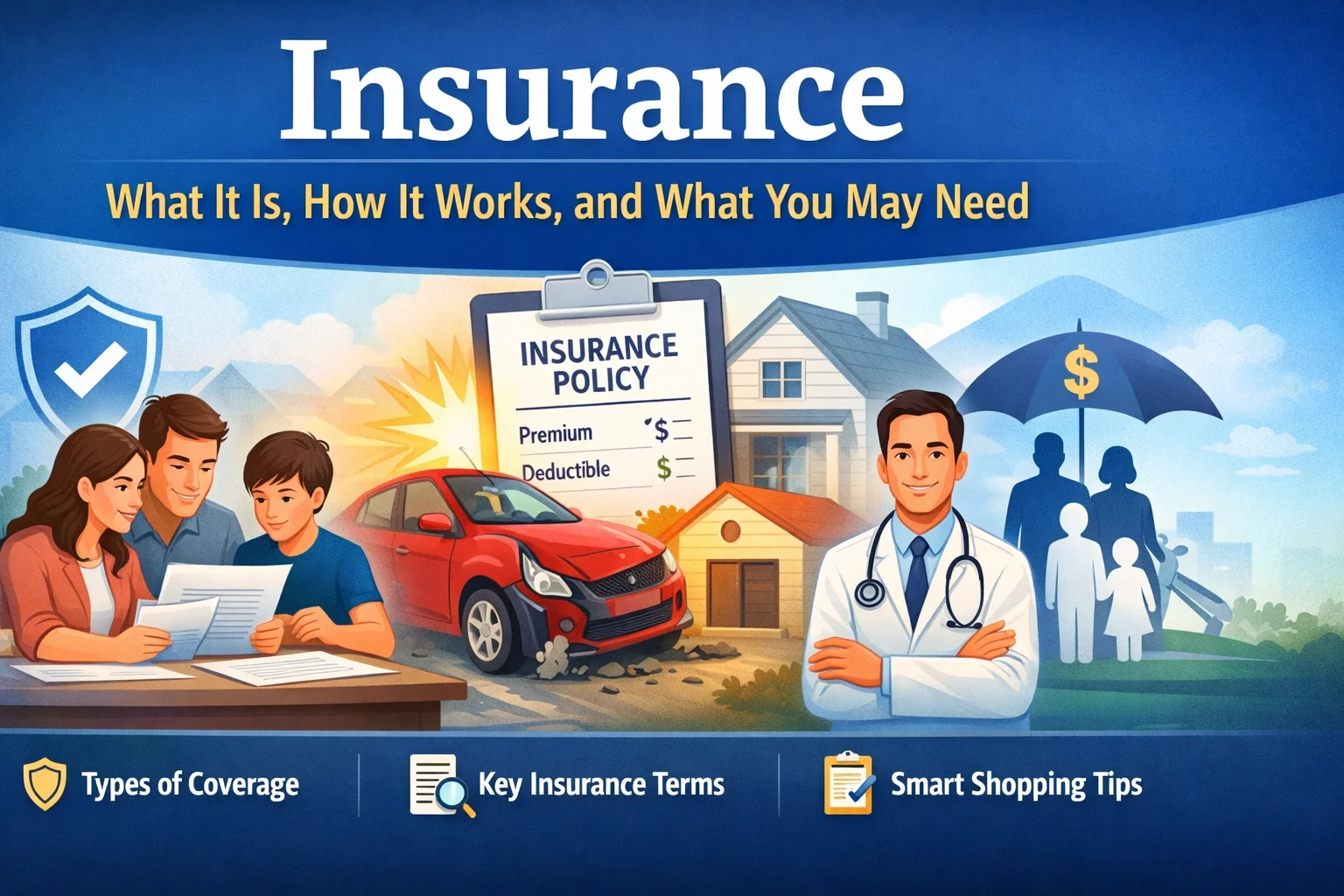
Insurance can feel confusing because every policy has its own rules, limits, and jargon. At its core, though, insurance is a way to protect yourself from a financial hit you may not be able to absorb on your own. This guide explains what insurance is, how it works, the main types people in the US run into, what common terms mean, and how to compare coverage without getting lost in the fine print.
Quick Answer
Insurance is a contract that helps cover certain financial losses in exchange for a premium. The right policy can protect your income, savings, property, or family, but only for losses your policy actually covers.
Key Takeaways
- Insurance shifts part of your financial risk to an insurer in exchange for a premium.
- A lower premium often comes with a higher deductible or less coverage.
- Auto, health, home, renters, and life insurance are the most common personal policy types.
- Every policy has limits, exclusions, and conditions, so “covered” never means “everything.”
- State rules matter, especially for auto insurance and some health coverage rules.
- The best policy is not always the cheapest one. It is the one that fits your risks and budget.
What Insurance Is
Insurance is a legal contract between you and an insurer. You pay the insurer a premium, usually monthly, semiannually, or annually. In return, the insurer agrees to pay for certain covered losses, up to the limits in your policy.
The basic idea is risk sharing. Many people pay into the system, but only some will file claims in a given year. That lets insurers spread risk across a large group instead of leaving one person to handle a major loss alone.
In plain English, insurance is there to help when a loss would otherwise be hard to handle from your own savings.
How Insurance Works

Every policy has a few moving parts.
A premium is what you pay to keep the policy active. A deductible is the amount you pay out of pocket before the insurer starts paying on covered claims that have deductibles. A policy limit is the most the insurer will pay for a covered loss or over the policy period, depending on how the policy is written.
You will also see the word liability. Liability coverage helps pay when you are legally responsible for someone else’s injuries or property damage. In auto insurance, for example, liability coverage is different from coverage for damage to your own car.
If a covered event happens, you file a claim. The insurer reviews the facts, checks the policy terms, and then decides what it will pay. That payment may be reduced by your deductible, your policy limit, exclusions, depreciation, or other policy conditions.
The Main Types of Insurance Most People See
The insurance world is huge, but most households deal with a small set of policies.
Health insurance helps pay for medical care. It is often the most important coverage for avoiding large bills, but out-of-pocket costs can still include deductibles, copays, and coinsurance.
Auto insurance helps cover injuries, property damage, and, depending on your policy, damage to your own vehicle. In most states, drivers must carry at least some minimum coverage to drive legally.
Homeowners insurance helps protect your home structure, personal belongings, liability exposure, and sometimes extra living expenses after a covered loss.
Renters insurance usually covers your belongings, personal liability, and loss of use if your rental becomes temporarily unlivable after a covered event. It does not insure the building itself.
Life insurance pays money to a beneficiary if the insured person dies while the policy is in force. It is often most useful when other people depend on your income.
Other common policies include disability insurance, umbrella insurance, long-term care insurance, and business insurance.
What Insurance Usually Covers
Coverage depends on the policy type, but most insurance is built around one of three goals: protecting property, protecting against liability, or helping with major expenses.
A policy may pay to repair a car after a crash, replace belongings stolen from an apartment, cover legal damages you owe after an accident, or help pay hospital bills. Some policies also include extra protections through endorsements or riders, which are add-ons that change the standard policy.
An endorsement can increase jewelry coverage on a homeowners policy, add water backup coverage, or raise liability limits. In life insurance, a rider may add options such as accelerated death benefits or waiver of premium.
What Insurance Does Not Cover
Insurance never covers everything. Each policy has exclusions, which are losses the policy does not pay for.
For example, standard home insurance often does not cover flood damage or earthquake damage unless you buy separate coverage or an add-on, depending on the insurer and state. Auto insurance does not cover routine maintenance. Health insurance does not mean every doctor, treatment, or prescription is covered the same way. Life insurance may not pay in cases tied to fraud or other policy violations.
This is why the declarations page and policy wording matter so much. The headline coverage name is only the starting point.
The Terms That Matter Most
The fastest way to understand a policy is to know a few terms that show up everywhere.
A premium is your payment for the policy.
A deductible is the part of a covered loss you pay before insurance contributes, when that coverage has a deductible.
Liability is your responsibility for damage or injury you cause to others.
Collision usually refers to coverage for your car if it hits another vehicle or object, or overturns.
Comprehensive usually refers to non-collision vehicle losses such as theft, vandalism, hail, flood, or hitting an animal.
A policy limit is the maximum the insurer will pay.
An exclusion is something the policy does not cover.
A rider or endorsement is a policy add-on or change.
Your out-of-pocket cost is what you pay yourself, including deductibles and, in health insurance, things like copays or coinsurance.
Replacement cost generally means the cost to repair or replace property with similar new property, without subtracting depreciation.
Actual cash value usually means replacement cost minus depreciation. That often leads to a lower claim payout than replacement cost coverage.
Who Needs Insurance and Who May Not
Most adults need at least some insurance, but not the same mix.
You likely need health insurance unless you have another solid source of coverage. You likely need auto insurance if you own or drive a car, and in many states you legally must carry it. You likely need renters insurance if replacing your belongings out of pocket would be painful. You likely need homeowners insurance if you own a home, and your lender will usually require it if you have a mortgage. You likely need life insurance if someone depends on your income or would struggle with your final expenses.
On the other hand, you may not need every available policy. For example, someone with no dependents may not need much life insurance. A person driving an older car with low market value may decide collision or comprehensive coverage is no longer worth the premium. A high-net-worth household may need more liability coverage, not less.
The goal is not to own every policy. The goal is to insure the risks that could seriously disrupt your finances.
What Affects Cost
Insurance pricing varies, sometimes a lot, because insurers look at risk, coverage choices, and local conditions.
For personal policies, common factors include your age, location, claims history, coverage limits, deductible level, property features, vehicle type, driving history, and whether you bundle multiple policies. In life and health coverage, age, health, tobacco use, and plan design can matter heavily.
In simple terms, broader coverage, lower deductibles, and higher limits often cost more. Narrower coverage, higher deductibles, and lower limits often cost less. The trade-off is what you would have to pay yourself after a loss.
| Factor | Usually pushes price higher | Usually pushes price lower |
|---|---|---|
| Coverage limits | Higher limits | Lower limits |
| Deductible | Lower deductible | Higher deductible |
| Claims history | Recent or repeated claims | Clean claims history |
| Vehicle or property risk | Expensive or high-risk item | Lower-risk item |
| Bundling | Separate policies | Multi-policy discount may help |
State Rules and Minimums
Insurance is heavily regulated at the state level in the US, which is one reason requirements and policy rules can differ from one state to another.
Auto insurance is the clearest example. Most states require drivers to carry at least minimum liability coverage or show another approved form of financial responsibility. Those minimums are legal minimums, not necessarily good protection. If you cause a serious accident, state minimum limits may run out quickly.
Health coverage rules can also vary depending on whether you get insurance through an employer, a federal Marketplace plan, a state Marketplace, Medicare, Medicaid, or another source.
That is why broad advice should always be checked against your state and your insurer’s actual policy language.
How To Compare Insurance Without Getting Burned
A cheap quote is not always a good quote. Compare policies in the same order every time.
Start with the coverage type and limits. Then check the deductible. After that, look closely at exclusions, endorsements, and claim-related conditions. Ask whether the quote is based on actual cash value or replacement cost where that distinction matters. Make sure you understand whether your liability limits are enough for your income, assets, and risk level.
It also helps to compare at least three quotes using the same coverage settings. Otherwise, one insurer may look cheaper only because it is offering less protection.
A smart comparison is not just “Which premium is lowest?” It is “What am I getting, what am I giving up, and what would I owe after a bad day?”
Common Mistakes
One common mistake is buying only the legal minimum and assuming that means you are fully protected. Another is focusing on premium alone while ignoring deductibles and limits.
People also miss exclusions. That is especially common with flood losses, high-value items, water backup, business use of personal property, and optional coverages for vehicles.
Another mistake is failing to update coverage after a move, marriage, divorce, new driver, home renovation, major purchase, or income change. Insurance should change when your life changes.
Finally, many people wait until after a loss to learn whether they had replacement cost coverage or actual cash value coverage. That can be an expensive surprise.
A Simple Step-By-Step Way To Choose Coverage
Start by listing the losses that would hurt you most. Medical bills, lawsuits, a totaled car, a house fire, or lost income all belong on that list.
Next, separate required coverage from optional coverage. Then decide what you could realistically afford to pay out of pocket if you had a claim. That number helps you choose a deductible.
After that, compare quotes with matching limits and deductibles. Read the exclusions. Ask about endorsements or riders if you have a special risk, such as expensive jewelry, a home office, or a teen driver.
Before you buy, check the insurer’s complaint information, financial strength references where relevant, and your state insurance department resources.
FAQs
Is insurance required by law?
Sometimes. Auto insurance is required in most states, and lenders often require home or auto coverage when they have a financial interest in the property. Other policies, like life or renters insurance, are usually optional unless required by contract.
What is the difference between premium and deductible?
Your premium is what you pay to keep the policy active. Your deductible is what you pay out of pocket on a covered claim before the insurer pays its part, when the coverage includes a deductible.
Is the cheapest insurance policy good enough?
Not always. A cheaper policy may come with lower limits, more exclusions, or a higher deductible. Compare the protection, not just the price.
What does liability insurance do?
Liability insurance helps pay for injuries or property damage you cause to others when you are legally responsible. It does not usually pay for damage to your own property unless another coverage applies.
What is actual cash value vs. replacement cost?
Actual cash value usually pays the item’s depreciated value. Replacement cost usually pays what it costs to repair or replace the item with a similar new one, without subtracting depreciation.
How many quotes should I compare?
At least three is a reasonable starting point, as long as the coverage settings are the same. That makes the comparison more meaningful.
Sources
- National Association of Insurance Commissioners (NAIC)
- USA.gov
- HealthCare.gov
- Insurance Information Institute (Triple-I)
- Progressive insurance glossary and consumer education pages
- GEICO insurance glossary and coverage guides
Conclusion
Insurance is really about protecting yourself from losses that would be hard to handle alone. The right policy depends on your risks, your budget, and what you could afford to pay out of pocket after a claim.
Do not judge coverage by premium alone. Check limits, deductibles, exclusions, and how the policy would respond in a real-life loss.
Your next step is simple: list the risks you actually need to insure, then compare a few policies using the same coverage settings.
CTA
See FINSSURE’s guides on auto, renters, homeowners, life, and health coverage to compare the policies most relevant to your situation.